Klaro
How Klaro works

Everything a solo business owner needs, in four groups.

Start wherever fits. Use one tool or all of them. Every answer you get is based on your actual numbers — not generic advice.

Get started free
Who it's for

Built for people running a business on their own.

Klaro is not for enterprise teams or funded startups. It's for the person who is the business — doing the work, handling the clients, and figuring out the numbers without a finance department.

Consultants & coaches
You sell your expertise by the hour or project and need to know what to charge.
Makers & product sellers
You make physical goods and need to understand your real cost and margin.
Cleaners & home service pros
You run a solo or small crew operation and need to quote jobs confidently.
Freelancers & creatives
You do design, writing, photography, or development and want to stop undercharging.
New business owners
You have an idea or just started and need a plan, a structure, and a number to aim for.
The toolkit

Four groups. Start free. Go deeper when you're ready.

Every tool in Klaro fits into one of four groups. Free tools are open immediately — no account needed. Pro tools unlock when you upgrade.
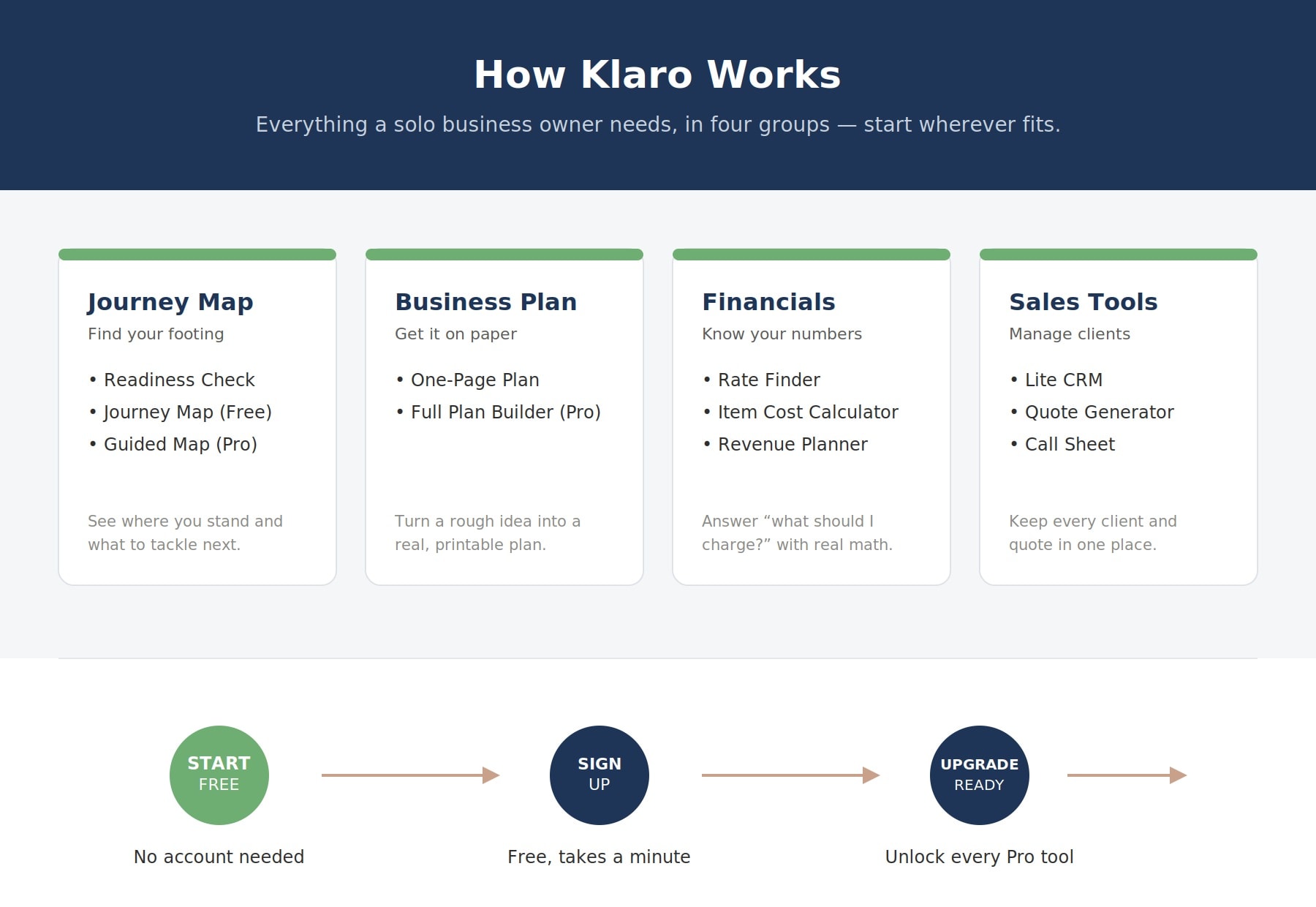
How Klaro works — four tool groups (Journey Map, Business Plan, Financials, Sales Tools) and the free-to-pro upgrade path

What each group does

Journey Map

Readiness Check (Free)Journey Map (Free)Guided Map (Pro)

See where you stand and what to tackle next. The Readiness Check gives you an honest score on your idea. The Journey Map shows your five-stage path. The Guided Map breaks every stage into concrete tasks with sub-steps you can check off.

Business Plan

One-Page Plan (Free)Guided Business Plan (Pro)

Turn a rough idea into a real document. The One-Page Plan gets you a printable plan in 7 questions. The Guided Business Plan walks you through seven guided steps with real financial math and produces a complete document.

Financials

Pricing Calculator (Free)Product Cost Calculator (Pro)Revenue Planner (Pro)Profit Check (Pro)

Answer "what should I charge?" with real math, not a guess. Pricing Calculator calculates your minimum viable rate. Product Cost Calculator finds your true margin on any product. Revenue Planner turns your monthly goal into a weekly action. Profit Check shows what you actually made on a job or across a time period.

Sales Tools

Quote Generator (Pro)Client Hub (Pro)Client Call Planner (Pro)Order Tracker (Pro)

Keep every client and quote in one place. Quote Generator builds professional itemized quotes. Client Hub tracks every lead and client with follow-up dates. Client Call Planner helps you prep before a sales call and capture what happened after. Order Tracker moves accepted work from new to completed.

Free vs Pro — what changes

Free gets you started. Pro gets you operational.

Free
4 tools — no account needed
Readiness Check, Journey Map, One-Page Business Plan, Pricing Calculator
Instant results — no setup
Use on any device
Pro — $12/month
Everything in Free
8 additional tools unlocked
Guided Map with sub-step tracking
Guided Business Plan with financial math
Product Cost Calculator, Revenue Planner, and Profit Check
Quote Generator, Client Hub, Client Call Planner, and Order Tracker
Data saved to your account across devices
Business structure basics

What do these terms actually mean?

Plain-language definitions for the most common business structure terms.

Not legal or tax advice. These are general definitions only. Talk to an accountant or attorney before choosing a business structure — the right choice depends on your specific situation.
Sole Proprietorship
The simplest structure — you and your business are legally the same entity. No registration required in most states (beyond a local business license). You report business income on your personal tax return. The downside: your personal assets (savings, car, home) are on the hook if the business is sued or owes money.
LLC (Limited Liability Company)
A legal structure that separates you from your business. If the business gets sued or can't pay a debt, your personal assets are generally protected. You register with your state (typically $50–$500), and taxes usually still flow through to your personal return. Popular with solo business owners who want liability protection without the complexity of a corporation.
S-Corp (S Corporation)
A tax election, not a separate business structure. An LLC or corporation can choose S-Corp tax treatment with the IRS. The main benefit: once your business is profitable enough, you can split income between a salary and distributions — potentially reducing self-employment taxes. Comes with more paperwork (payroll, separate filings). Usually worth exploring once you're consistently earning $50k+ in profit.
DBA (Doing Business As)
A registered trade name that lets you operate under a name different from your legal name or LLC name. For example, "Jane Smith LLC" might do business as "Bright Leaf Design." A DBA is not a separate legal entity — it's just a name on file with your county or state. Required in most places if you want to open a bank account or sign contracts under a business name.
Why Klaro exists
"Most business tools assume you have a team. If you're doing this alone, you get spreadsheets, YouTube tutorials, TikTok gurus, and a lot of guesswork instead. Klaro is the toolkit I wish I'd had when I started."

Klaro is built for the person who is the business — no team, no back office, just you. Every tool gives you a real number or a real document in under five minutes, not a 30-page report you'll never open.

Start free — no credit card